
Why sustainable performance depends not just on how hard employees work, but on how effectively they recover.
In today’s workplace, productivity is often measured by how much employees accomplish, how quickly they respond, and how consistently they deliver results. Full calendars, back-to-back meetings, and long workdays have become familiar signs of professional commitment.

But what if one of the most effective ways to improve performance is to create more opportunities for recovery?
Consider a high-performing employee who regularly works through lunch, responds to emails late at night, and moves from one demanding project to another without taking a meaningful break. Initially, this dedication may produce impressive results. Over time, however, concentration begins to decline, small mistakes become more frequent, and enthusiasm gives way to exhaustion.
The problem is not necessarily a lack of motivation or ability. It may be a lack of recovery.
Research in neuroscience, occupational health, and organizational psychology increasingly supports an important principle: Rest is not the opposite of productivity. It is one of the conditions that makes sustained productivity possible.
For HR leaders, wellness professionals, and organizational decision-makers, understanding the science of recovery offers an opportunity to rethink how organizations support employee health, engagement, and long-term performance.
Understanding the Science Behind Recovery
The human body is designed to alternate between periods of activity and recovery. During demanding work, the brain and body use energy, mobilize attention, and activate physiological stress responses.
These responses are useful in the short term. They help employees meet deadlines, solve complex problems, and respond to unexpected challenges.
Problems arise when high demands continue without sufficient opportunities to recover.
The body’s stress-response systems, including the sympathetic nervous system and the hypothalamic-pituitary-adrenal (HPA) axis, help people respond to pressure. When stress becomes prolonged, inadequate recovery can contribute to sleep disturbances, fatigue, and difficulties with concentration and emotional regulation.
Recovery allows physiological and psychological systems to return toward baseline.
Researchers Sabine Sonnentag and Charlotte Fritz have identified four important psychological recovery experiences:
- Psychological detachment: Mentally disconnecting from work during nonworking hours.
- Relaxation: Engaging in activities that reduce tension and promote calm.
- Mastery: Pursuing enjoyable challenges or learning experiences outside work.
- Control: Having freedom to decide how personal time is spent.
These experiences demonstrate that recovery involves more than simply stopping work. It also requires opportunities to mentally disengage, restore energy, and regain a sense of autonomy.
Sleep: The Foundation of Cognitive Performance
Among all recovery behaviors, sleep remains one of the most important.
Sleep supports memory consolidation, learning, emotional regulation, and attention. Inadequate sleep can impair judgment, reduce reaction speed, and make routine tasks more difficult.
The Centers for Disease Control and Prevention recommends that most adults ages 18 to 60 obtain at least seven hours of sleep per night.
Yet workplace practices often interfere with healthy sleep habits.
Late-night emails, unpredictable schedules, extended shifts, and expectations of constant availability can make it difficult for employees to maintain consistent sleep routines.
The consequences extend beyond individual fatigue.
A widely cited RAND Corporation analysis estimated that insufficient sleep costs the United States up to $411 billion annually in economic losses, largely through reduced productivity and increased mortality risk. Although this estimate is based on earlier economic modeling, it illustrates the substantial organizational implications of inadequate sleep.
Employers can support healthier sleep by establishing reasonable communication expectations, limiting unnecessary after-hours work, providing predictable schedules, and educating employees about sleep health.
Importantly, sleep education alone cannot compensate for workloads or scheduling practices that routinely prevent adequate rest.
Why Breaks Improve Performance
Many employees believe that working continuously demonstrates greater dedication. However, sustained attention is a limited resource.
Research suggests that taking breaks during the workday can help reduce fatigue and improve well-being. The benefits for immediate task performance vary depending on the nature of the work, the duration of the break, and the activity involved.
A 2022 systematic review and meta-analysis published in PLOS ONE found that micro-breaks were associated with increased vigor and reduced fatigue. Performance benefits were less consistent, particularly for highly demanding cognitive tasks.
This distinction matters. Breaks are valuable even when they do not immediately produce measurable increases in output.
Organizations can encourage recovery through practical changes such as meeting-free intervals, protected lunch periods, brief movement breaks, and opportunities to step away from screens.
For example, a customer service team might introduce short recovery intervals between demanding call blocks. Rather than measuring success solely through call volume, managers could also monitor employee fatigue, service quality, and error rates.
The goal is not to maximize break frequency. It is to design work so employees can maintain attention and effectiveness throughout the day.
The Hidden Costs of an Always-On Workplace
Modern technology has made it easier to work from almost anywhere. Unfortunately, it has also blurred the boundaries between professional and personal life.
Employees may finish their scheduled workday but continue thinking about unfinished tasks, checking notifications, or preparing for tomorrow’s responsibilities.
This constant mental connection can interfere with psychological recovery.
The health implications of excessive working hours are particularly concerning. A joint World Health Organization and International Labour Organization analysis estimated that working 55 hours or more per week contributed to approximately 745,000 deaths from stroke and ischemic heart disease worldwide in 2016.
Although these findings do not establish that every demanding schedule is harmful, they reinforce the importance of managing prolonged work exposure.
Organizations should recognize that recovery cannot depend entirely on individual discipline. Employees need realistic workloads, supportive managers, and permission to disconnect without fearing professional consequences.
Building a Workplace Culture That Supports Recovery
Creating a recovery-friendly workplace does not require expensive wellness programs. Often, the most meaningful improvements come from changing everyday management practices.
- Make Recovery a Leadership Priority
Managers influence whether employees feel comfortable taking breaks, using vacation time, and disconnecting after work.
Leaders who consistently send late-night messages or praise excessive working hours may unintentionally communicate that availability matters more than effectiveness.
Instead, managers should model reasonable boundaries and evaluate performance through meaningful outcomes rather than hours spent online.
- Design Workloads Around Sustainable Performance
Recovery initiatives are unlikely to succeed if employees face unrealistic deadlines and chronic understaffing.
HR and operational leaders should regularly review workloads, staffing levels, overtime patterns, and competing priorities.
For organizations with shift-based employees, predictable scheduling and adequate time between shifts deserve particular attention.
- Encourage Different Forms of Recovery
Employees have different recovery needs.
Some benefit from physical activity, while others prefer quiet time, social connections, creative hobbies, or simply uninterrupted rest.
Offering flexibility helps employees choose activities that genuinely restore their energy rather than treating wellness as another obligation.
- Protect Time Away From Work
Organizations can establish communication guidelines, discourage unnecessary after-hours messages, and ensure employees can use earned time off without accumulating overwhelming backlogs.
The principle is simple: Time away from work should actually feel like time away from work.
Measuring the Impact of Recovery Initiatives
For organizational decision-makers, recovery should be treated as a measurable component of workforce well-being.
A practical evaluation framework can combine employee feedback with operational indicators.
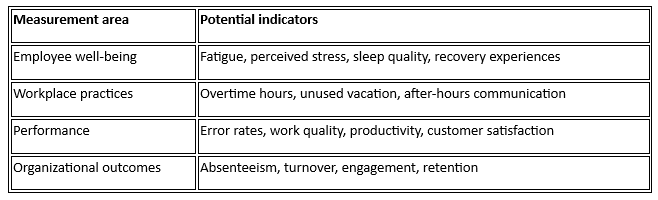
Organizations can begin with a confidential baseline survey, implement targeted improvements, and reassess results after 90 days.
For example, a department experiencing frequent overtime might introduce workload reviews, meeting-free focus periods, and clearer after-hours communication expectations.
Success would not be measured by participation alone. Leaders would examine whether employees report lower fatigue while maintaining or improving service quality and operational performance.
These measures should be analyzed in aggregate, with appropriate privacy protections. Improvements should also be interpreted carefully because workload, staffing, and business conditions can influence outcomes.
Conclusion: Recovery Is a Performance Strategy, Not a Perk
High performance is not achieved by pushing employees to operate at maximum intensity indefinitely.
It depends on balancing meaningful effort with sufficient opportunities to recover.
Sleep, breaks, manageable workloads, psychological detachment, and supportive leadership all contribute to an environment where employees can perform effectively without sacrificing their long-term health.
For HR leaders and wellness professionals, the opportunity is to move beyond simply encouraging employees to practice self-care. The more important challenge is creating workplace conditions that make recovery possible.
Start by examining one critical question: Does our organization reward sustainable performance, or does it unintentionally reward exhaustion?
The answer can guide practical improvements in scheduling, management expectations, workload design, and wellness strategy.
Ultimately, organizations that take recovery seriously are investing in more than employee comfort. They are building the foundation for healthier people, stronger engagement, better decisions, and more sustainable organizational performance.
References:
- The Recovery Experience Questionnaire: Development and Validation of a Measure for Assessing Recuperation and Unwinding from Work
- Short Sleep Duration and Sleep Difficulties Among Adults
- Why Sleep Matters: The Economic Costs of Insufficient Sleep
- Give Me a Break! A Systematic Review and Meta-Analysis on the Efficacy of Micro-Breaks for Increasing Well-Being and Performance
- Long Working Hours Increasing Deaths from Heart Disease and Stroke